The different ways to charge a battery

  • 114 Views
  • Last Post 8 hours ago
Inception posted this 4 days ago

I also have purchased the smaller Universal Charger, which refurbishes all types of batteries. I started the large battery project with it, but because it was intended for smaller batteries I thought I should use the industrial types to speed up the process. 
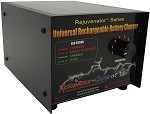
The Universal charger has given new life to many automotive batteries, as long as the cells have not swelled too much from winter freezing. In my collection I have many 10+ year old refurbished batteries: 26 were 7V Prius "BAD" NiMH modules that I got online, which are ~20 years old.

I accidently revived a Lithium razor battery thinking it was NiMH, which is not recommended, however, the charger was very effective nonetheless.

Every experimenter should have something like this, to keep ALS batteries desulfated and NiMH at full capacity. If you have not made your own radiant energy battery charger, consider getting something like the RC-1AU Universal Battery Charger.

Inception

  • Liked by
  • Jagau
  • Fighter
Order By: Standard | Newest | Votes
Inception posted this 4 days ago

I also have purchased the smaller Universal Charger, which refurbishes all types of batteries. I started the large battery project with it, but because it was intended for smaller batteries I thought I should use the industrial types to speed up the process. 

The Universal charger has given new life to many automotive batteries, as long as the cells have not swelled too much from winter freezing. In my collection I have many 10+ year old refurbished batteries: 26 were 7V Prius "BAD" NiMH modules that I got online, which are ~20 years old.

I accidently revived a Lithium razor battery thinking it was NiMH, which is not recommended, however, the charger was very effective nonetheless.

Every experimenter should have something like this, to keep ALS batteries desulfated and NiMH at full capacity. If you have not made your own radiant energy battery charger, consider getting something like the RC-1AU Universal Battery Charger.

Inception

  • Liked by
  • Jagau
  • Fighter
Jagau posted this 3 days ago

Yes, Inception and you can even build one using the recommendations from Chapter Seven,

specifically "Battery Chemistry Made Easy," in John Bedini's first SG book.

He explains very well how this type of charger performs better than conventional chargers that don't reach the critical voltage.

He has also made several YouTube videos to explain and prove this fact and remove traces of sulfation and he compare to one when the battery is not charged correctly.

Jagau

  • Liked by
  • Inception
  • Fighter
Vasile posted this 3 days ago

Quoting:Inception


Every experimenter should have something like this, to keep ALS batteries desulfated

Do you happen to know if it works on already sulfated batteries? I have some 12V, 8Ah UPS batteries that I haven't charged in years and they now have less than 1Volt and can not be charged with conventional chargers. 

Inception posted this 2 days ago

Replying To: Vasile

It is likely that you can restore most batteries. It may take a lot of time if very heavily sulfated, or if there is a metalic short from internal rust it may not fully charge. 

I am surprised how many I have recovered. It has restored larger batteries beyond the listing on the charger cover.

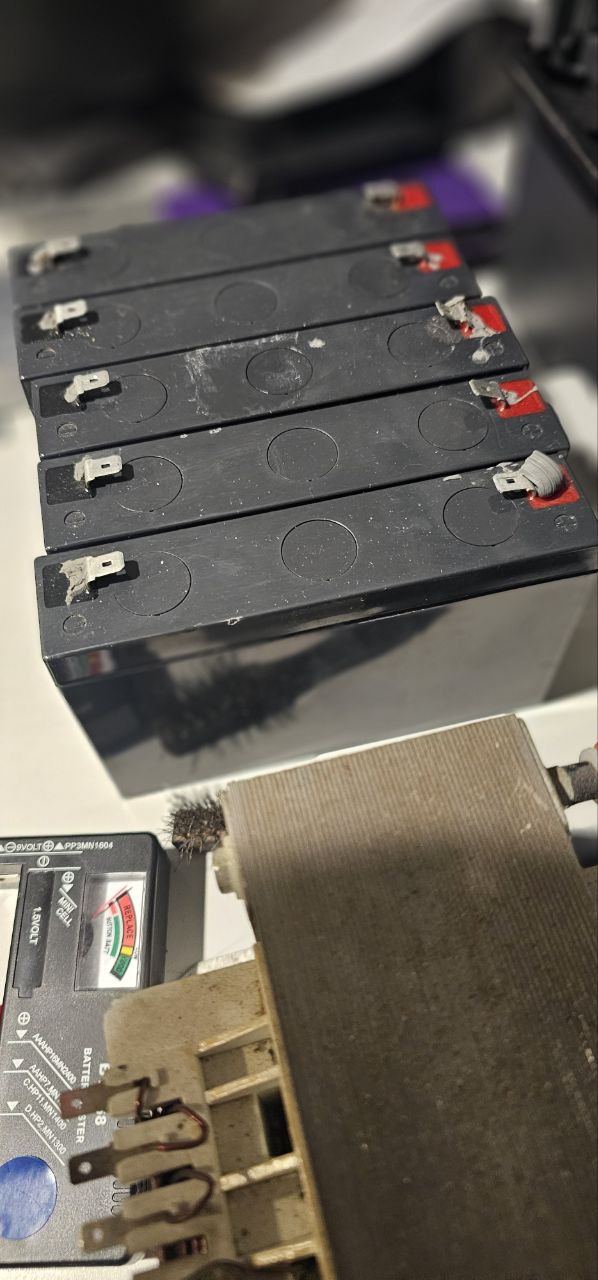
6V UPS batteries that were dead and given to me from an IT tech:

I plan to make a battery bank for experiments that will have a 6V incremental voltage selector.

I have recovered 12V and 6V UPS batteries, but they must be soluble inside. If the gel gets too hard you may not be able to revive it. Pry open the seal and pop each rubber cap off of the cells. Add distilled water just below the opening.

The setting for those type is #6 on the dial. If the battery acts shorted and pops the circuit breaker, reset it and turn down the dial until cells come up to the right voltages: 2+, 4+, 6+, 8+, 10+, 12+.

I can usually get most to come up to 10 -11 volts and then it takes longer to get the + side cell to desulfate.

One could easily say that this charger has paid for itself may times, especially with the Prius modules and all the AA and AAA NiMh batteries revived besides car, mower, and tractor batteries.

I revived the 12V deep discharge Prius battery as well, when it would only charge to ~11V. That battery has lasted twice its normal lifetime. I have revived it twice.

I have well over a dozen battery chargers. Some are old school brute force and ohers are (stupid) smart chargers. None of them have worked like this one and the majority are in the parts bin from failure. We call them all "battery burners".

Inception

Jagau posted this 2 days ago

Hi Inception and Vasile
We should all know this little secret.
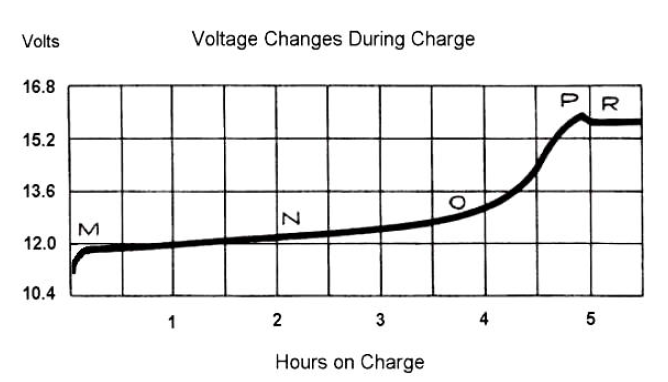
Most standard chargers stop charging at 14.8 V the charge is incomplete according to this table:

John Bedini says:
If the charge process is stopped before point "P" is reached, it means that some sulfate ions are still left in the plates. If, for any reason, the voltage is prevented from rising to the finishing level, the charge will NOT complete.
This is another "little secret" of the battery industry. By limiting the voltage that most battery chargers provide to 14.8 volts, they know that the batteries will only last for a certain number of cycles, because a small amount of the sulfate ions are (purposely) being left in the plates at the end of each charge.

So, repeated incomplete charging is what causes most batteries to fail. A lead-acid battery that is charged to a finishing voltage at the end of each charge cycle can easily operate for 5,000 charge and discharge cycles, which is over 15 years of service. This is how to make your batteries last a very long time.


I have been managing a fully solar-powered radio communication network for several years, and I can confirm that following the Bedini method by reprogramming my industrial-type charge controllers to the values ​​recommended by JB has resulted in my batteries lasting on average between 12 and 14 years. I know it sounds incredible, but I have experienced this for several years. The batteries (lead acide) don't have time to sulfate with this charging principle. For some sites, I use the programmable Morningstar PS30M charge controllers.

PS Information and image taken from the book The Complete Beginner's Handbook page 76, buy it, it's a plus.

Jagau


  • Liked by
  • Inception
  • Fighter
Vasile posted this 2 days ago

Quoting:Jagau


Interesting stuff. Makes you wonder if the people that make "conventional chargers" actually know about this curve and stop the charging intentionally at 14.8V.

Inception posted this 2 days ago

Jagau, you are correct.

Also, the large deep cycle batteries can refuse charging at 1.9V per cell. I recently experienced this. All the pressure beyond that will not keep a 2+ volt charge. The Tesla pulsing technique makes all the difference when reviving those cells. I have to use the 2V radiant rejuvenator to break through that barrier.

My Amish friend also uses the Morningstar controllers. I've had to bring my laptop to his shop to update his firmware and program it. His father's store is 100% solar and they recently switched to lithium batteries, but his clock shop still utilizes ALS batteries.

What set-points are you using for the chargers? I have a TRACE inverter/charger on the forklift type batteries. I have not reset the values in a very long time. The batteries were installed in 1999 and not maintained by the occupant as instructed.

Inception

  • Liked by
  • Jagau
  • Fighter
Jagau posted this 2 days ago

Quote Vasile

wonder if the people that make "conventional chargers" actually know about this curve and stop the charging intentionally at 14.8V

As an friend of mine working in the field said: There's too much money to be made with this; if they leave them like this, we'll sell even more batteries.

It's a bit like back when LED flat screens had been out for a while and we'd all been trained to maintain them, but the good old, very expensive CRT TVs were still on the market—still too much money to be made with them.

Excuse my complaints, but I've been there.

Yes, everything about battery charging is very interesting, and I think Chapter 7 should be read and understood by everyone.
Fortunately, Morningstar's Pro series solved the problem. I've only used these models since the 2000s and have never had any sulfation problems.

Quoting Inception:

What set-points are you using for the chargers? 

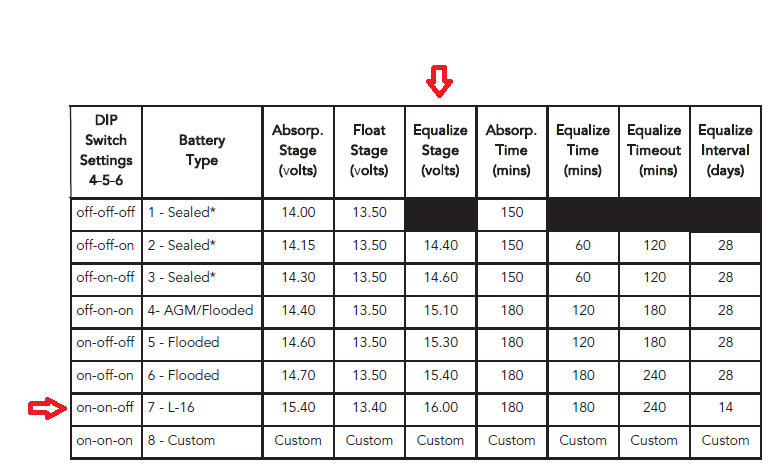
If you look at the specs of the PS30M here:


The L16 series goes up to 16.75V. So, as JB said, he was absolutely right.
You just need to program it in the right place. What is important when charging a battery in order to get the maximum is its equalization time which comes immediately after the absorption time.

 Yes, these are high-quality controllers programmable at home or remotely; a host of other options are available with curves, so you get your money's worth. Note that like JB I only use deep cycle batteries of the flooded lead-acid type. We've strayed a bit from the Adams topic, but it's for a good cause!

Jagau

Inception posted this 2 days ago

I am reviving these beasts. They weight a ton.

Trace uses "Bulk" for absorption phase.

Would Setting #6 be adequate?

Inception

Jagau posted this yesterday

Hi inception

Hi Inception
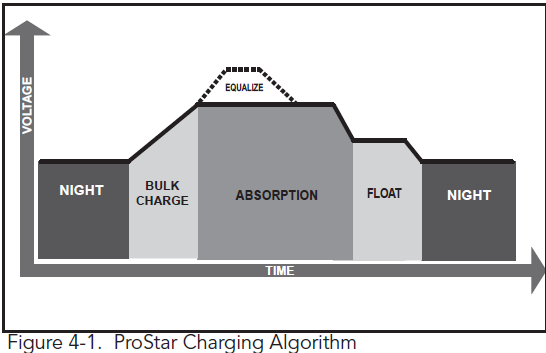
I'm somewhat less familiar with the Trace made by Xantrex, and i think they also have an equalization phase. Give me the model of your Trace, and I'll check the manual to see how to program the equalization that follows the absorption phase.

You'll see this graph in your manual.

Jagau

  • Liked by
  • Fighter
Inception posted this yesterday

I am back at the battery site. We got another 8 inches of snow. The highways were cleared this trip.

I had packed many more tools and supplies than previous trips but forgot my Trace manual. I can find it online.

TRACE SW4024

Inception

  • Liked by
  • Jagau
  • Fighter
Close